
The Unlikely Legend of Colonel Sanders: The Man Behind the Bucket |
Discover the incredible true story of Colonel Sanders, the man who turned a secret recipe and a lifetime of failures into the global empire of KFC. |
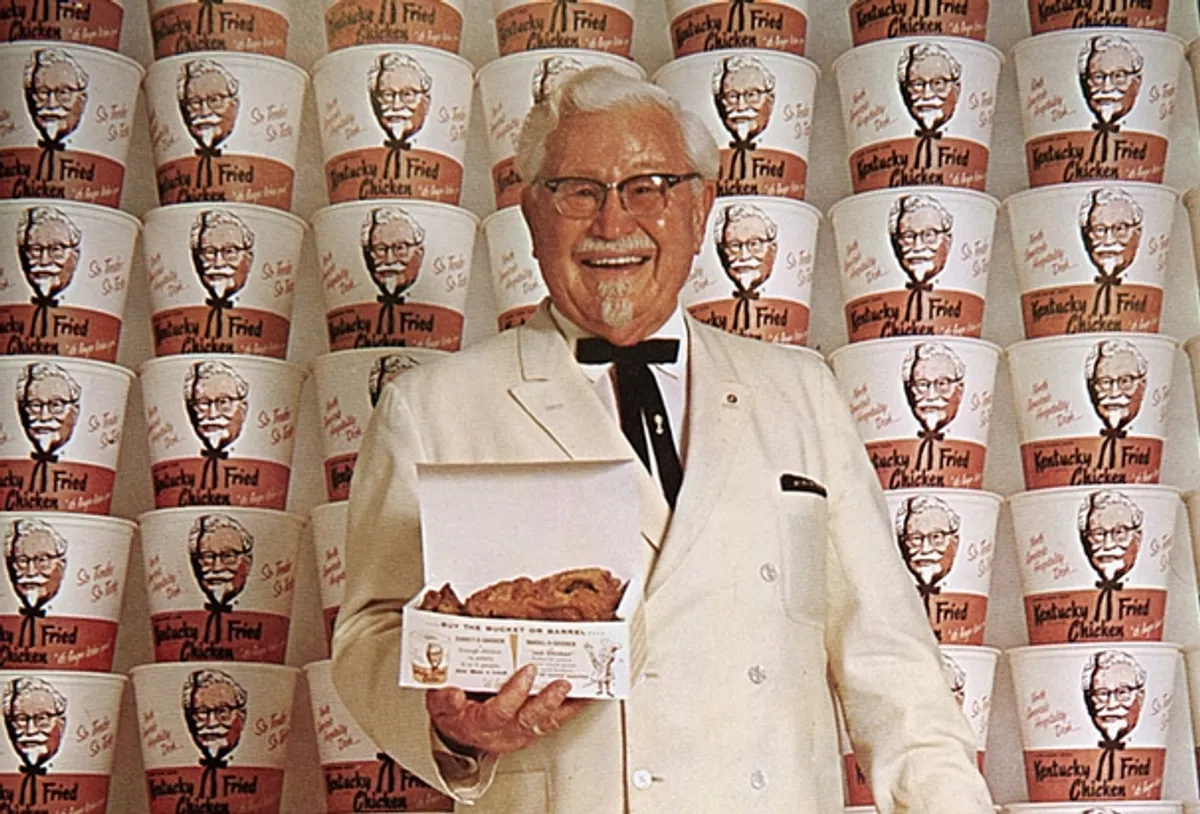
Long before the white suit, the black string tie, and the globally recognized smile, Harland Sanders was just a man wrestling with failure.
His journey to becoming the iconic Colonel Sanders was not one of privilege or Ivy League degrees; it was a winding, often brutal road paved with dozens of odd jobs and failed ventures.
Born in Henryville, Indiana, in 1890, Sanders was forced into responsibility at the age of six when his father passed away, leaving him to cook for his younger siblings while his mother worked.
That early start in the kitchen planted a seed that would, decades later, blossom into an international phenomenon.
But the path was anything but straight.
Over the years, he tried his hand as a steamboat pilot, railroad fireman, insurance salesman, and even a lawyer, a career that ended abruptly after a courtroom brawl with his own client.
Each setback, however, seemed to inch him closer to his destiny.
The turning point came during the Great Depression, a time of widespread hardship that for Sanders, became a moment of opportunity.
At age 40, he was running a Shell service station in Corbin, Kentucky, where he began serving meals to hungry travelers from his own dining table.
The food, especially his pan-fried chicken, quickly became more popular than the fuel he sold.
He soon moved across the street, opening the Sanders Court & Café, a 142-seat restaurant and motel that became a beloved local institution.
It was here, in this humble roadside kitchen, that the legend of Kentucky Fried Chicken truly began.
Perfection of a Secret Recipe
Colonel Sanders was obsessed with quality.
He knew his chicken was good, but pan-frying was too slow, taking 30 minutes an order.
Deep-frying was faster but often resulted in a dry, unevenly cooked product.
In 1939, Sanders discovered the commercial pressure cooker and adapted it into a pressure fryer.
This was a game-changing innovation.
It cooked the chicken quickly while sealing in the moisture and flavor, creating a product unlike anything else available.
A year later, in 1940, he finalized his now-famous secret recipe of 11 herbs and spices.
This secret blend, locked away in a vault, remains one of the most valuable and protected trade secrets in business history.
His success in Corbin was so notable that in 1935, Governor Ruby Laffoon bestowed upon him the honorary title of Kentucky Colonel, a moniker he would embrace for the rest of his life.
A New Road, A New Beginning
For years, business at the Sanders Court & Café boomed, but a new threat emerged in the mid-1950s: the construction of Interstate 75.
The new highway would bypass his restaurant entirely, threatening to wipe out his business.
Faced with ruin at an age when most men consider retirement, the 65-year-old Sanders made a bold decision.
He auctioned off his restaurant for just enough to pay his debts, packed his car with a pressure cooker and his secret spice blend, and hit the road.
His plan was audacious: convince restaurant owners to sell his chicken and pay him a nickel for every piece sold.
It was the birth of the modern restaurant franchise model.
The first successful Kentucky Fried Chicken franchise was not in Kentucky, but in Salt Lake City, Utah, sold in 1952 to his friend Pete Harman.
Harman, a sign painter, coined the name "Kentucky Fried Chicken" and created the iconic bucket, forever changing the takeout food landscape.
Sanders traveled the country, often sleeping in his car, tirelessly pitching his recipe.
By 1963, there were over 600 KFC locations in the United States and Canada, making it the largest fast-food operation in the country.
The Colonel Becomes an Icon
The rapid expansion became too much for the aging Sanders to manage.
In 1964, at the age of 73, he sold the company to a group of investors led by John Y. Brown Jr. and Jack C. Massey for $2 million.
As part of the deal, he received a lifetime salary and became the company's living symbol and brand ambassador.
It was a role he was born to play.
Dressed in his immaculate white suit, he became one of the most recognizable figures in the world.
His image was everywhere, his folksy charm and commitment to quality defining the brand for a generation.
However, his relationship with the company's new owners was often fraught with tension.
Fiercely protective of his creation, Sanders grew critical of cost-cutting measures that he felt diminished the quality of the food.
He famously criticized the new gravy, comparing it to "wallpaper paste," and sued his former company for using his image to endorse products he didn't develop.
Despite the friction, he remained the undeniable face of KFC until his death.
A Lasting Legacy in Kentucky and Beyond
Colonel Sanders passed away from leukemia on December 16, 1980, at the age of 90, and was buried in Louisville, Kentucky.
His legacy is more than just a fast-food chain; it's a testament to resilience, reinvention, and the power of a good idea.
Today, visitors can travel to Corbin, Kentucky, to see the restored Sanders Cafe and Museum, a site listed on the National Register of Historic Places.
The museum offers a glimpse into the life of the Colonel, with his original kitchen and a model motel room preserved as they were in the 1940s.
It stands as a monument to a man who failed at nearly everything until he succeeded beyond his wildest dreams.
From a roadside diner in the hills of Kentucky to over 30,000 locations worldwide, the story of Colonel Sanders is a powerful reminder that it's never too late to start something new.
His journey proves that passion and persistence can turn a simple recipe into a global empire.
Our reader's top Questions
What did Colonel Sanders do before KFC?
Before creating his famous chicken recipe, Harland Sanders had a wide variety of jobs, including railroad fireman, insurance salesman, steamboat operator, and even a short-lived career as a lawyer.
Where was the first Kentucky Fried Chicken restaurant?
While Colonel Sanders first developed and sold his chicken at his roadside restaurant in Corbin, Kentucky, the very first official Kentucky Fried Chicken franchise was opened in Salt Lake City, Utah, in 1952 by Pete Harman.
How much did Colonel Sanders sell KFC for?
In 1964, at the age of 73, Colonel Sanders sold the KFC company to a group of investors for $2 million. The deal also included a lifetime salary and a permanent role as the brand's ambassador. |





0 Comments
Join the conversation
Be the first to comment
Share your thoughts above.